GET IN TOUCH

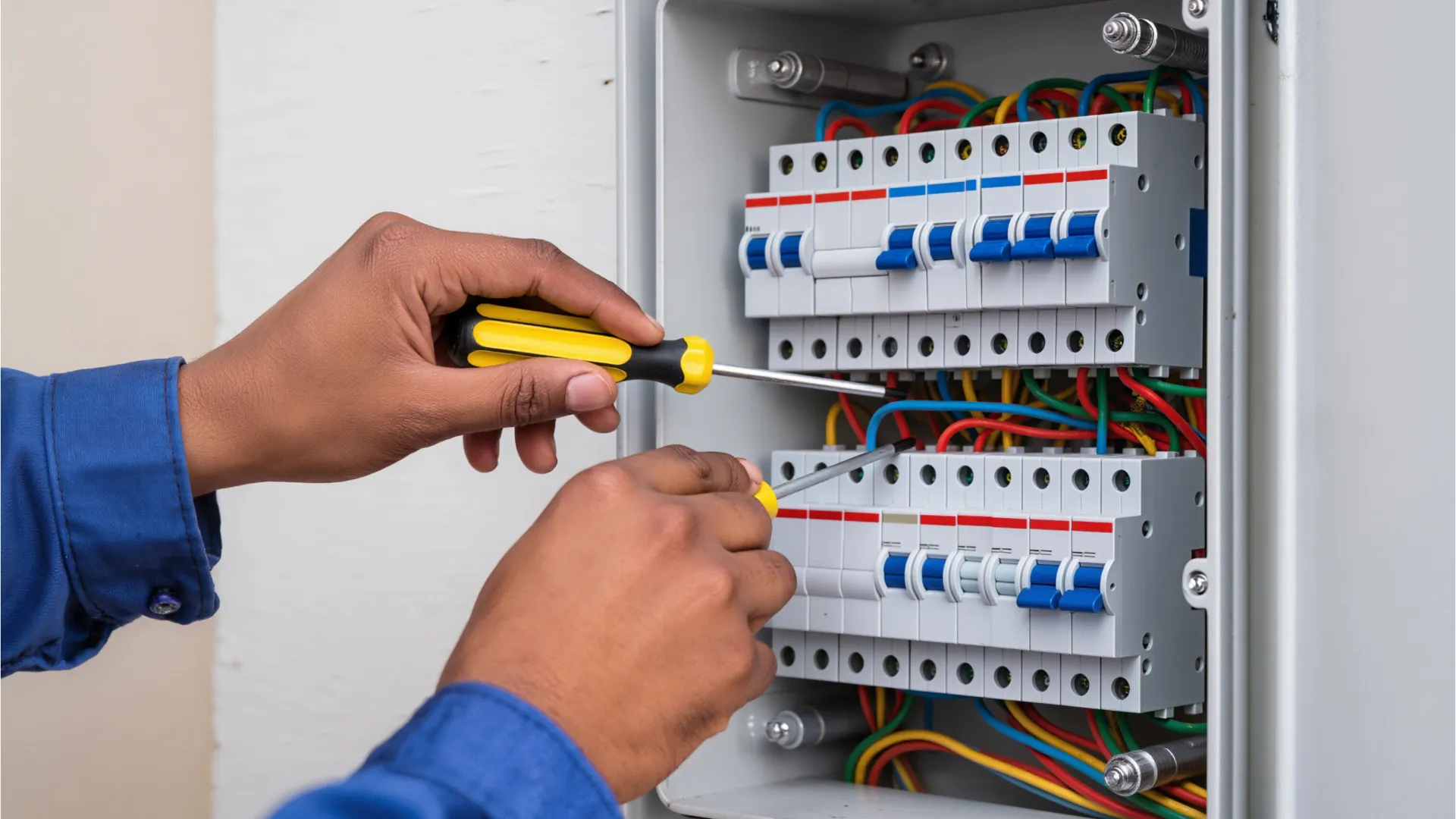
If your RCD keeps tripping, it’s normally doing exactly what it is designed to do. It’s annoying, but it’s there to protect people from electric shock, not to protect appliances, and definitely not to protect convenience.
We deal with this sort of thing on callouts fairly often. Someone’s power goes off, they reset the switch, it trips again, and now they’re wondering if they’re wondering if they’ve got a serious fault. Sometimes they have. Sometimes it’s something pretty straightforward. Either way, it is worth approaching it properly rather than repeatedly forcing it back on.
If you’re in a commercial or industrial setting, it’s also worth keeping in mind the legal side of it. RCD trips can be the first sign that something’s deteriorating, and you don’t really want to be discovering that after an incident.
Electric Technics Ltd provides commercial and industrial electrical services across the UK, including testing and fault investigation work.
What an RCD Actually Does
An RCD (Residual Current Device) monitors the balance of electricity going out and coming back on a circuit.
If some of that electricity leaks away somewhere, it shouldn’t, through damaged insulation, moisture, or (worst case) through a person, it trips quickly and cuts the power. That “imbalance” is the key point. If it trips, it’s detected current going to earth that shouldn’t be there.
Modern standards have pushed PCD protection onto more circuits over the years for good reason. It’s one of the simplest, most effective safety devices in an electrical system.
What to do When it Trips
First thing: don’t keep resetting it over and over again. People do it without thinking, but if there is a genuine fault, you’re basically trying to power up something that’s already told you it isn’t happy.
A sensible way to narrow it down is:
- Switch off and unplug anything you can on the affected circuit
- Reset the RCD
- Plug things back in one by one
If it trips as soon as you plug a particular item in, you’ve probably found the culprit. Appliances with heating elements are common offenders (kettles, dishwashers, washing machines, hand dryers) Outdoor equipment can also be another one.
If it trips immediately even with everything unplugged, that usually points to the circuit or wiring rather than a simple appliance. That’s when you stop and get it tested properly.
The Most Common Reasons RCDs Trip
In most cases, it falls into a fewer familiar categories:
- Faulty appliances: Heating elements can develop slight leakage to earth as they age. From the outside the appliance looks fine, but internally it’s letting current escape. Enough leakage and the RCD will trip.
- Moisture or water ingress: We see this a lot with outdoor sockets, garden lighting, garages, plant rooms, washdown areas, and anywhere condensation is a thing.
- Damaged cables: Cables trapped behind furniture, nicked during maintenance, crushed in trunking, or just degraded with age can all leak to earth. On older installations, brittle insulations, brittle insulation is a common one, especially where there’s been heat, vibration, or plenty of “small changes over time”.
- Wear and tear in the installation: Connections loosen. Accessories crack. Enclosures take a knock. Small faults build up quietly. An RCD tripping can be the visible symptom that the installation needs attention, even if it’s been “fine for years”.
- Several small leaks adding up: This one catches people out. There isn’t one obvious faulty item, it’s just that lots of equipment leaks a small amount of each, and the total pushes the RCD over its limit. Offices with a lot of IT kit, kitchens with multiple appliances, or sites that have gradually added equipment over time are where we tend to see it.
Why You Shouldn’t Ignore Repeated Trips
A one-off that never happens again can be a fluke. A trip that keeps coming back is a warning sign.
If you keep resetting the RCD without finding the cause, you’re effectively normalising a fault condition. And the whole point of the RCD is to remove power when something unsafe is happening.
We’ve been to sites where people have lived with nuisance tripping for months, and when it’s finally investigated it turns out to be a pretty serious insulation issue or moisture damage that’s been slowly getting worse. Catching it early is nearly always cheaper and less disruptive.
How Electric Technics Ltd Can Help
Proper RCD fault-finding isn’t guesswork, and it isn’t “swap a part and hope”. It needs methodical testing, safe isolation, and the right kit to confirm what’s going on.
At Electric Technics Ltd, we carry out electrical testing and investigation work for commercial and industrial environments, including EICRs and fault identification.
If you want the service pages, these are the most relevant ones:
- Electrical testing
- Commercial and industrial electrical services
- Industrial sector support
Sometimes the fix is simple. Sometimes it highlights an underlying issue, an overloaded circuit, ageing accessories, moisture ingress, or a distribution setup that’s no longer ideal for the site. If the system needs improving, we’ll tell you straight and explain what the options actually are, without making it into a drama.
If your RCD keeps tripping and you want it checked properly, contact us at Electric Technics Ltd.